
The last three or four shows I’ve done have been Meyer Sound shows. I love all the ULTRA family boxes. They’re really easy to use.”
Bobby AitkenSound Designer
Sound Designer Bobby Aitken has built the soundscape for “Pride” on Meyer Sound systems through sold-out runs at Cardiff’s Sherman Theatre and the National Theatre’s Dorfman Theatre. As the hit musical moves to London’s Bridge Theatre, where previews begin Nov. 12, he is reshaping that design for its third home this year.
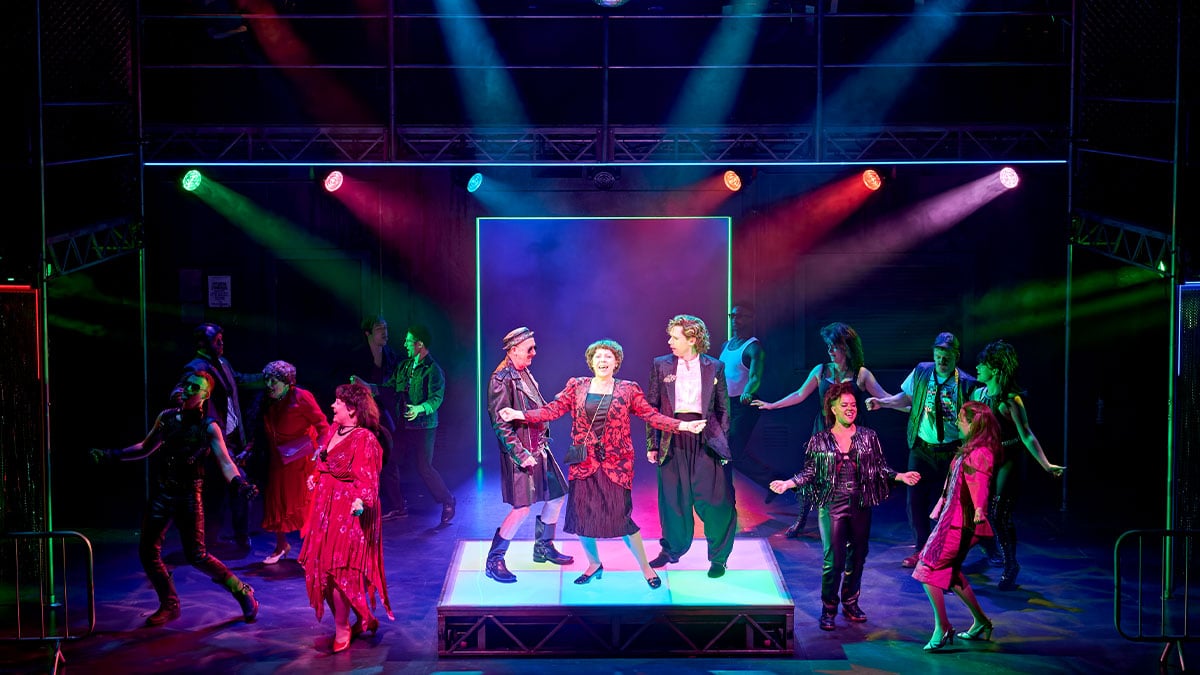
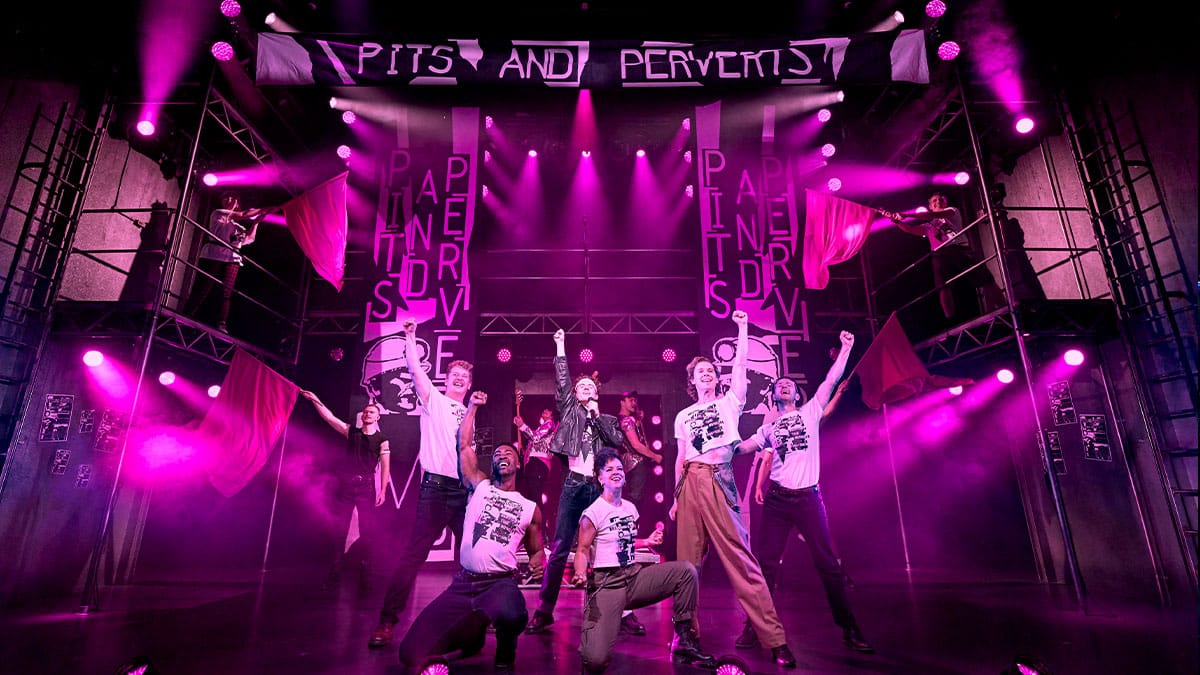
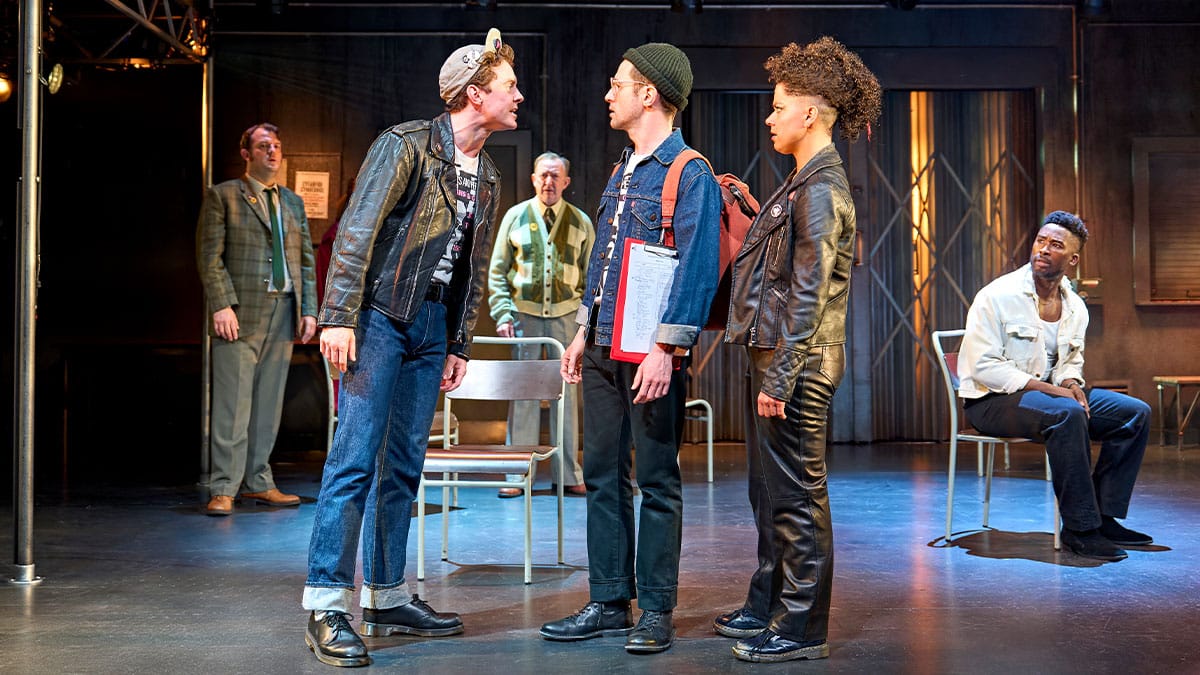
Based on the 2014 film, “Pride” tells the true story of Lesbians and Gays Support the Miners, a group of London activists who raised money for a South Wales mining village during the 1984-85 miners’ strike. The original score by Christopher Nightingale, Josh Cohen, and DJ Walde ranges from pop and rock to protest songs.
“The show has quite a lot of Welsh choral music, because they love a bit of choral singing in Wales, but also has a lot of 1980s disco when we’re in London, so the sound system is quite a challenge, trying to make things big and powerful for the disco and wide and immersive for the more traditional choral pieces,” says Aitken, whose career spans the West End, Broadway, and arena productions, from “Mamma Mia!” and “Standing at the Sky’s Edge” to the London 2012 Olympics opening ceremony.
A Wider Room Calls for Line Arrays
In Cardiff and at the Dorfman, the production relied on Meyer Sound ULTRA‑X80 point source loudspeakers. At the Bridge, the wider auditorium requires wider dispersion, so Aitken has turned to line arrays for the first time in the show’s life.
Ten-box LEOPARD line arrays at house left and right carry the music, and a flown seven-box LEOPARD center array handles vocals. “We’ll no doubt end up sneaking some vocals into the left-right as well, but we try to keep the vocals separate from everything else,” Aitken says.
ULTRA‑X42, ULTRA‑X40, and ULTRA‑X20 point source loudspeakers serve as fills and delays, and UPJunior and UP-4XP loudspeakers serve as principal surrounds. Four 2100‑LFC low-frequency control elements fly with the center array, and a 900-LFC low-frequency element supports each side array. Five Galileo GALAXY Network Platforms drive the system.
“Our maximum throw here is probably less than 20 meters, which is a joy, actually,” he says. “Using a line array, it’s a different sound. It’s not nearly as direct or rock and roll-y. That’s something for us to get used to.”
Compact Loudspeakers Fit Tight Theater Spaces
“The last three or four shows I’ve done have been Meyer Sound shows,” says Aitken, who has worked with Meyer Sound systems over the past 30 years. “I love all the ULTRA family boxes. They’re really easy to use.”
“One of the biggest challenges we have in theater sound is, it’s not just about the sound; quite often, the geometry of these rooms is so difficult to get loudspeaker systems into,” he explains. “So it’s about finding loudspeakers with the form factor to fit into nooks and crannies.”
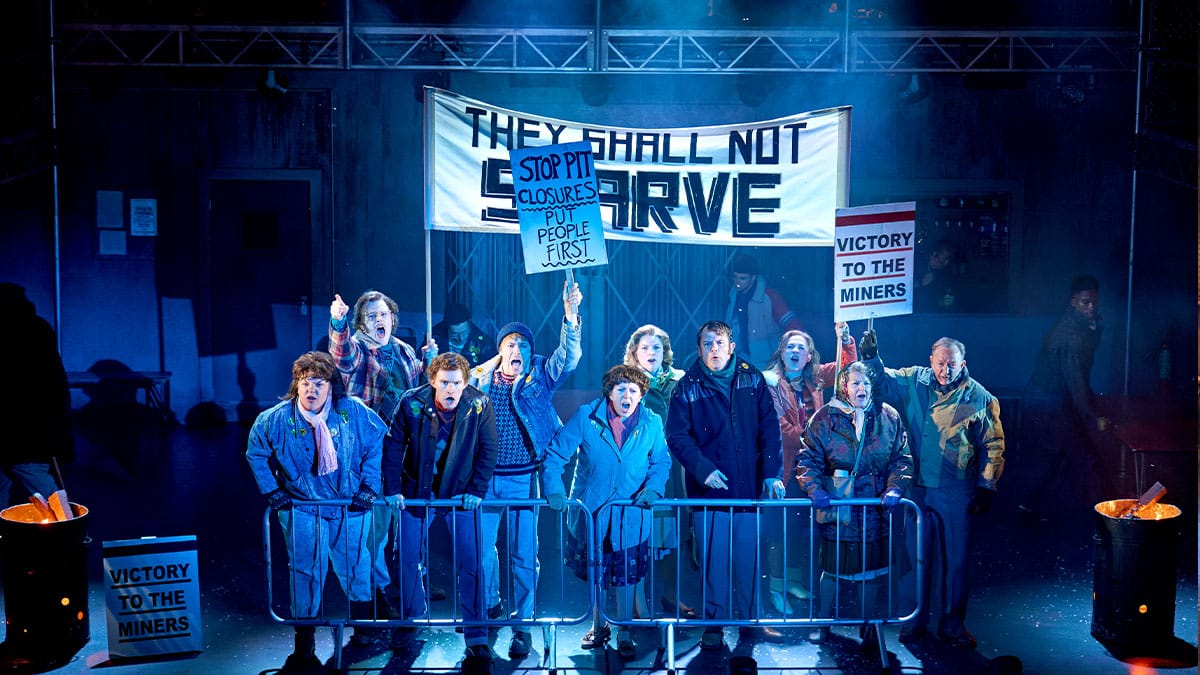
Onstage, the action moves between outdoor scenes, from picket lines to the Pride march, and indoor ones, and the surround system, part of the design in all three venues, marks the difference.
“Outdoor scenes, there’s not much we can do to the room acoustic,” Aitken says. “But for the indoor scenes, we use various room Atmos plugins, and we have a lot of surround in the auditorium. We put room tones and early reflections into the rooms, which make them sound like meeting halls and various spaces.”
Live Band and Playback Share the Stage
In addition to a cast of 25, a seven-piece, all-female band plays onstage and on an upstage balcony. “We use about 36 radio mics,” Aitken says. “We go between head mics and hand mics quite a lot.”
“There are some protest songs and chants, and we try to make those sound outdoorsy,” he says. “We’ll play-back tracks that were recorded with 30 people outdoors.”
Playback also fills out the score, including iconic 1980s synth lines that would need more keyboards than the stage can fit. “I think the skill is always using that stuff judiciously,” Aitken says. “Especially on a show like this, it’s important to believe in the performances.”
Aitken does nearly all of his work with the same small team. “Finding the right loudspeakers is important, as is finding the right control equipment and the correct microphones,” he says. “The most important thing without any shadow of a doubt is just finding the right people to work with.” On “Pride,” that team includes Associate Sound Designer Jonas Roebuck, Production Sound Engineer Matt Berry, Sound Operator Merlin O’Brien, and Radio Mic Supervisor Laura Gingell, with music mixes by Nick Gilpin.
Across every layer of design, from the main LEOPARD arrays to the compact fills, delays, and surrounds, the Meyer Sound system works in service of the story. “I think these small boxes, like UP-4slims and ULTRA-X20s and ULTRA-X40s, sound great,” Aitken says.
“The show is both beautiful and impactful ,” he says. “It’s a powerful emotional journey.”